
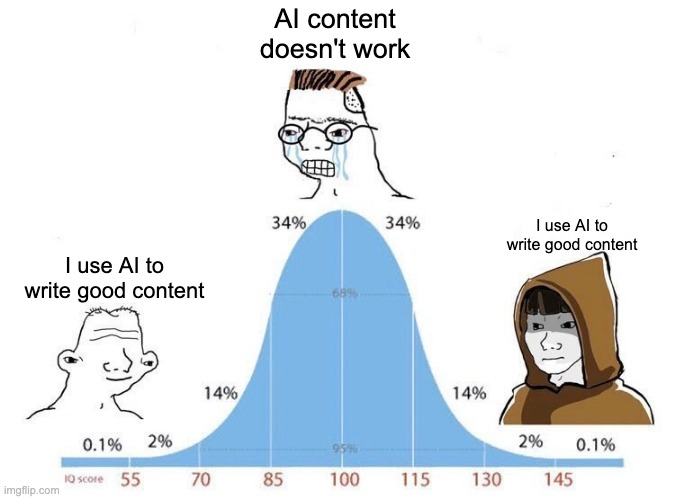
I'll save you the paragraph where I lament that AI-generated B2B SaaS content is "over-hyped" or "under-hyped". By now, you've probably gone through the hype-cycle three or four times and maybe even had some successes with a custom GPT, repurposing some content, or speeding up your research phase, but I'm betting it hasn't completely "transformed your workflow".
And I'd bet it's at least partially because you haven't gotten it to generate genuinely interesting content.
Note: For the purposes of this piece, let's ignore content generated for machines (SEO, AEO, GEO, etc.) and simply focus on creating genuinely interesting content for humans.
Whether you're looking to AI for productivity or quality improvements, I hypothesize there are three primary reasons it hasn't fully delivered:
- 1You aren't using enough unique data
- 2You aren't focusing enough on high-quality visuals
- 3You're not specific enough about who it's for
Let's tackle each of these so you can consistently generate content that's genuinely interesting.
1. Use unique data
If the data and research you're using is on the internet and can be accessed without a login, it's not unique. And as a result, your prospects are already getting that content from their AI.
There's good news though, you probably already have tons of unique data you can easily deliver to AI as context. Here are a few examples:
Data you already have
Your recorded Gong calls
Conversations with prospects and customers - the exact language they use to describe their problems.
Your internal Zoom recordings
Do you have weekly product meetings where you discuss customer problems? Great, turn that into thought-leadership content.
Your codebase
If you're a B2B SaaS company, the source of truth for the reality of what your customers experience is in the code.
Your database
This is a classic, but the most successful content finds stats and trends. What are customers doing the most with your product? Do they input text - can you mine that text (within T&Cs, of course)?
Your Slack, Notion, Jira, etc.
Internal discussions often surface the clearest articulations of what makes your product different.
Data you can create
Run 1:1 research interviews
Platforms like User Interviews (now UserTesting) cost about $149/session, but do six of these and you might get 4 new pieces of content.
Run a survey
Even a simple one gives you proprietary data points that no one else has.
2. Focus on high-quality visuals
People don't read any more. They haven't for years. Even when they paid thousands of dollars for a single Forrester report pre-AI they didn't read; they skimmed.
And since then, the waves of poorly-generated AI content have caused many more to lose trust in content. The no-reading trend isn't slowing down. According to my high-school teacher friends, high-schoolers in top-tier Massachusetts schools can hardly read at all. I'd bet 10x more people skimmed the images in this blog post than read this sentence.
% of words actually read by page length
Based on 45,237 page views · Nielsen Norman Group research
Maximum realistic reading on an average page
Users read at most 28% of words, but 20% is more likely
79%
scan, don't read
Nielsen Norman Group
55%
leave in <15 seconds
Chartbeat
60%
never read past headline
American Press Institute
This isn't new
First web reading study concludes: "Users don't read"
Nielsen
Eye-tracking reveals F-pattern scanning behavior
Nielsen Norman Group
Quantified: users read max 28% of words on a page
ACM Transactions
60% of people don't read past the headline
American Press Institute
Nothing has changed. F-pattern still dominates.
Nielsen Norman Group
Sources: Nielsen Norman Group, "How Little Do Users Read?" (2008); Weinreich et al., "Not Quite the Average," ACM Transactions on the Web (2008); Chartbeat analysis (2014); American Press Institute (2014); Nielsen Norman Group, "F-Shaped Pattern of Reading on the Web" (2006, updated 2024)
So why in the world are we generating so much text? Probably because it's easier than visuals, and the people generating content tend to come from writing backgrounds, not visual-first backgrounds.
Visuals are one of the most powerful content opportunities you have to get your point across and so few teams are leveraging AI for their images.
To be clear, I'm not saying you should create lazy "exploding brain with lasers" AI-generated images. I mean high-quality, on-brand images, demos of your actual software, charts, graphs, and visuals that summarize your text.
If you sell a software product, your visuals already exist in your code. Code is text. AI is good with text. Use it to create visuals. Use AI to help you brainstorm with your designers. Record yourself reading the content into a screen. Copy and paste a graphic from Slack or a recording. Honestly, it could be a picture of your kid, something is better than nothing, I guarantee it.
3. Be specific about who it's for
I didn't generate this content, but I did write it with a human in mind and your AI should do that too.
I wrote it for a content marketer in a B2B SaaS company who has tried AI, seen some results, but feels like they spend nearly as much time massaging the AI than if they had just hired someone to manually create it. I've worked with a few of these folks personally, so I have a decent idea of the little nits around their workflows and what's going on in their world.
These are the exact content "spices" you should give your AI so it can create content that triggers our brains to feel like "this writer/content/company gets me" - which creates trust and, with it, genuine interest.
It's as simple as passing in your persona-based messaging as context with what you're asking AI to create.
The persona behind this article
I wrote this post with a specific person in mind. Here's exactly who - and why it matters.
Role
Content marketer
Company
B2B SaaS, Series A–C
AI experience
Tried it, seen some results
Core frustration
Spends nearly as much time massaging AI output as writing from scratch
What they've tried
Custom GPTs, repurposing workflows, AI for research
What they want
Content that's genuinely interesting - not just faster to produce
Why this works: If you matched 4+ of those attributes, you probably felt like this article was written for you. That's the feeling your AI-generated content should create. The more specific you are about who it's for, the more it resonates - even with people who don't match perfectly.
Bonus: Have it read aloud to you
Would you listen to it as a podcast? If not, make it pass the vibe check. Even better if you can make it sound like something you'd pay attention to on TikTok.
One more thing
If you want all of this without the manual assembly, PersonaBox connects to your code, your messaging, and your brand to turn your code updates into ready-to-post product updates. Basically this entire article as a workflow. It won't solve all your problems, but you will wake up to genuinely interesting AI-generated content your buyers and customers care about every day.
- Mike