
Most B2B SaaS teams include company social posts in their product marketing launch plans. Some might ask colleagues to reshare on X or LinkedIn. But if your goal is maximizing engagement and reach, the data says it should actually be the other way around: your team members should be the primary posters, with company accounts amplifying and resharing.
Company pages get significantly fewer views than people. We want faces tied to commentary. We want to know the builders. We want the stories behind each feature. For something to resonate, it has to connect on a human level.
This isn't new. And yet it's massively underused. About half of employees say they're willing to share company content, but organizations cite lack of time, clear strategy, or perceived interest as reasons they haven't rolled out proper programs. The lever is sitting right there. Most teams just haven't pulled it.
The numbers show LinkedIn personal pages are more effective than company pages
7x
more engagement on personal profiles
YC W26 analysis & Refine Labs
2%
of employees drive 20% of all social engagement
76%
of people trust individuals over brands
AdWeek & Edelman Trust Barometer
7x more engagement on personal profiles vs. company pages
I recently analyzed 446 original posts from 94 YC W26 company pages and 1,951 original posts from their founders and found that the median engagement for company page posts was 9 reactions vs. 62 reactions for founder posts.
Median reactions per post
Sources: 446 company page posts & 1,951 founder posts from 94 YC W26 companies; Refine Labs study (2.75x more impressions, 5x more engagement from employee posts with 46% fewer followers)
This tracks with a Refine Labs study that found employee posts generated 2.75x more impressions and 5x more engagement than the company page, despite having 46% fewer followers. Other datasets show engagement lifts as high as 8x.
The employee advocacy multiplier
2%
of employees sharing company posts
20% of all social engagement
3-5x
higher click-through rate
on employee reshares vs. brand posts
7x
higher conversion rate
on leads from employee advocacy vs. other channels
Marketing Advisory Network
800%
increase in social engagement
from organized advocacy programs
Social Media Today
76% of people trust individuals over brands
That's what AdWeek found — and the Edelman Trust Barometer backs it up, showing employees are perceived as more credible than CEOs when talking about company-related topics.
If you need more proof, look at the infrastructure that's been built around this thesis. Standalone employee advocacy platforms like EveryoneSocial, DSMN8, GaggleAMP, and Haiilo exist solely to operationalize it. Sprout Social and Hootsuite have shipped entire advocacy modules. Sprout reports that their own team drove more than 20 million impressions in a single year through employee sharing — more than all of their brand channels combined.
Platforms built around employee advocacy
 EveryoneSocial
 DSMN8
DSMN8 GaggleAMP
 Haiilo
 Sprout Social
 Hootsuite
Entire companies and product lines exist solely to operationalize employee social sharing.
Even LinkedIn itself has a "Notify Employees" button on company pages whose only job is to nudge your team to reshare from their personal profiles.
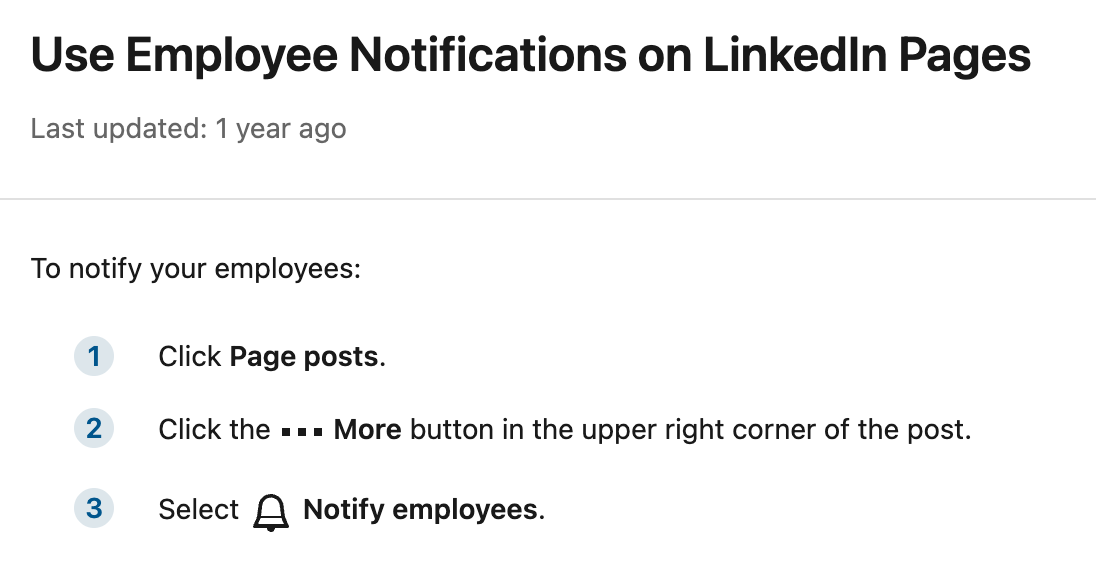
The infrastructure exists. The data is clear. Most teams just haven't operationalized it yet.
So what should you actually do?
If you're planning your next launch, make your team the primary distribution channel.
That means giving each person on the team — PMs, engineers, designers, leaders — the context and a first draft so they can write their own take on what shipped and why it matters.
But there's one place most teams stall out
Staring at a blank page is daunting for most. So, someone in your org still has to draft 5–10 unique, voice-authentic posts for different people on the team to get them started. Meanwhile, product marketing is already stretched thin writing the blog post, the changelog, the email.
Now you're asking them to ghostwrite for the VP of Engineering and the lead designer and the PM, each in their own voice? That's where it falls apart.
The bottleneck
Product marketing is already stretched thin. Adding 4+ ghostwriting tasks per launch is where teams give up.
This is one of the core problems we're solving with PersonaBox
When a feature ships, PersonaBox generates individual posts for each person on your team, in their voice and style. It learns how they actually write on X (or they can describe their tone and style), so what comes out doesn't read like a corporate template. It reads like them talking about something they helped build.
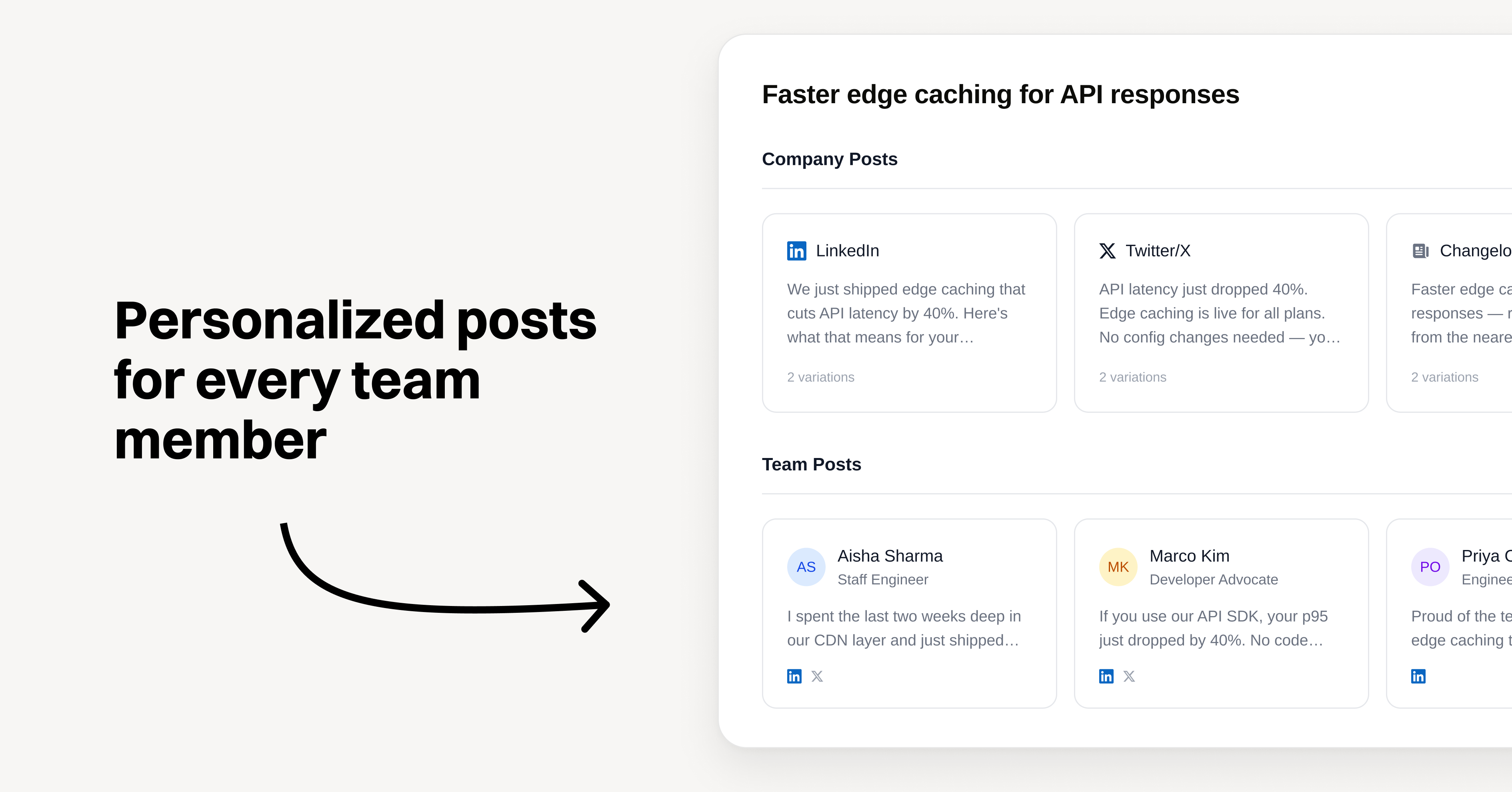
Voice-matched posts
Each post sounds like the person who'll publish it, not a corporate template. PersonaBox learns how they actually write.
Whole-team coverage
Generate posts for PMs, engineers, designers, and leaders in one go. No more ghostwriting bottleneck.
Want to see what this looks like for your team? Try PersonaBox with your next feature launch and see the difference when every post sounds like the person who wrote it.